Picture this: You’re excited about your first miniature kit. You order a Rolife book nook online, imagining cozy evenings assembling a tiny enchanted alley.
The package arrives, you tear it open—and the box says “Robotime.”
Panic sets in. Did you get scammed? Is this a knock-off?
I’ve heard this story hundreds of times in miniature forums and from my own workshop buddies. As a veteran model builder with over 20 years piecing together everything from Warhammer figurines to intricate dollhouses, I’ve dissected dozens of these kits.
The confusion between Rolife and Robotime is real, but it’s not a scam—it’s just poor branding clarity.
In this guide, I’ll break it down step by step, so you can shop confidently without wasting money on junk or duplicates.
The Simple Truth: Parent vs. Child Brands
Here’s the straightforward scoop: Robotime is the parent company, while Rolife and ROKR are its sub-brands.
Think of it like the automotive world—Toyota is the big parent company, producing reliable everyday cars, while Lexus is its luxury sub-brand for upscale rides.
Similarly, Robotime oversees the whole operation, founded in 2007 in China, specializing in laser-cut wooden puzzles and DIY crafts.
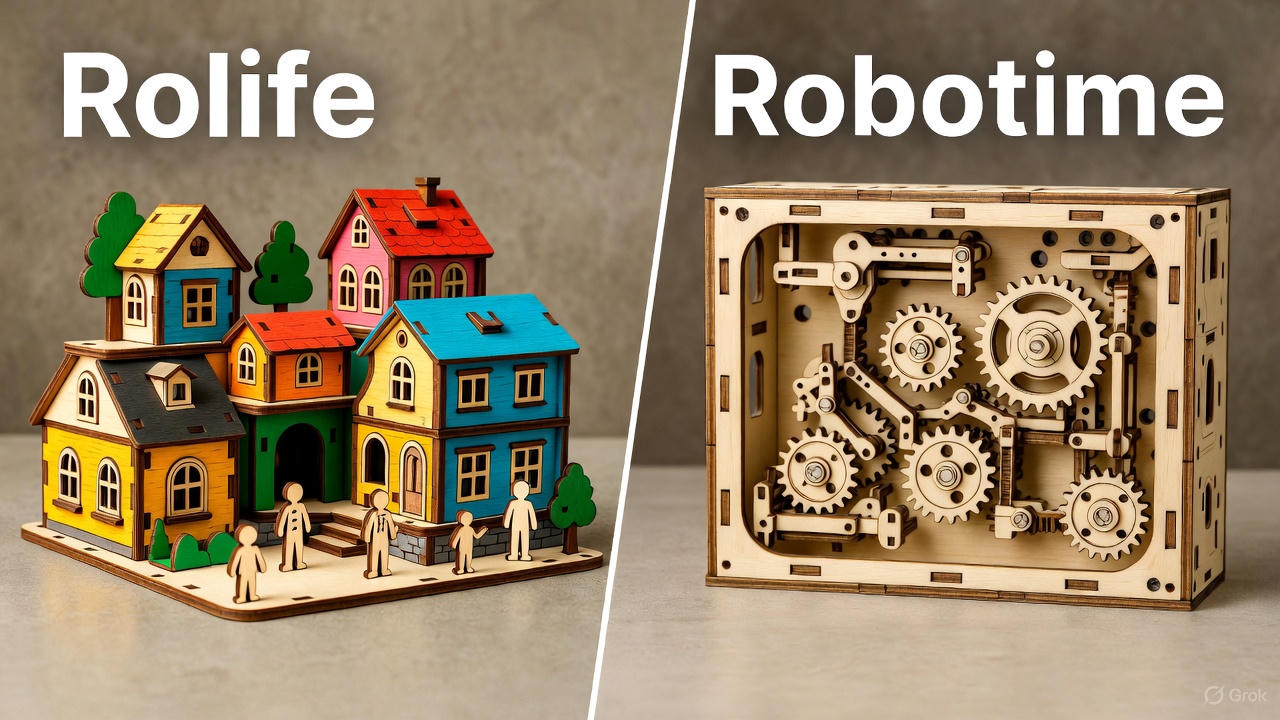
- Rolife focuses on artistic, decorative miniatures like book nooks and dollhouses.
- ROKR handles the mechanical, gear-driven models like marble runs and clocks.
This structure explains why your Rolife kit might arrive in a Robotime-branded box or with shared instructions. They’re all under one roof, sharing factories, quality standards, and even some parts.
From my research and hands-on experience, this setup allows Robotime to target different audiences without diluting their core identity.
Bottom line: If you see “Robotime” on a Rolife product, it’s legit.
Deep Dive: Rolife (The Artsy Side).
Rolife is the creative, whimsical arm of Robotime, launched around 2017 to appeal to decorators and crafters who love storytelling through miniatures.
Their kits are all about building tiny worlds—think enchanted bookstores, cozy cafes, or floral greenhouses.
- What do they make? Primarily book nooks (those shelf-insert dioramas) and miniature houses in 1:24 scale. For example, their Simon’s Coffee Shop kit (Review) is a bestseller: a two-story cafe with pre-printed wallpaper, tiny espresso machines, and LED lights.
- Who’s it for? Beginners dipping into miniatures, especially those who enjoy papercraft or decorating.
- Difficulty? Mostly easy to intermediate (10-20 hours per kit).
I built the Sakura Densya (a cherry blossom tram scene) in about 15 hours; the tabs fit perfectly, but you’ll need patience for the hundreds of tiny accessories like flowers and signs.
Rolife kits shine in their aesthetic appeal: vibrant colors, layered depth for illusion, and that “wow” factor when lit up.
If you’re into Harry Potter vibes or cozy aesthetics, Rolife is your jam.
Deep Dive: ROKR / Robotime (The Engineering Side)
On the flip side, ROKR (often just labeled as Robotime) is the engineering-focused sub-brand, emphasizing mechanical puzzles that move and function.
These aren’t just static displays—they’re interactive gadgets with gears, cranks, and sometimes even music or motion.
- What do they make? Mechanical models like marble runs, puzzle boxes, clocks, and globes. The Luminous Globe, for instance, is a standout: a wooden Earth that rotates with hand-cranked gears and glows with built-in LEDs.
- Who’s it for? Puzzle enthusiasts, STEM lovers, or anyone who geeks out over how things work.
- Difficulty? Intermediate to advanced (8-15 hours), but with more frustration potential if gears misalign.
Pro Tip: One thing to note about the Robotime/ROKR mechanical kits: wax the gears! The kit comes with a little block of wax. If you skip this step, your gears will grind and the model won't move smoothly.
I learned this the hard way on the Airship model—taking it apart to fix a stuck gear is a nightmare you want to avoid.
Material Differences
Materials are where the sub-brands diverge most noticeably, impacting build experience and durability.
Wood Quality: Both use laser-cut birch plywood, but ROKR opts for thicker 3-4mm sheets to handle mechanical stress from gears and moving parts.
This makes them sturdier but harder to bend. Rolife uses thinner 2-3mm wood for flexibility in curved designs, like arched windows.
Accessories: Rolife kits burst with extras—pre-printed papers for wallpapers, fabric for curtains, plastic props like tiny chairs. It’s glue-heavy for a polished look.
ROKR keeps it minimal: gears, axles, and rubber bands for motion, with a raw wood finish that highlights engineering precision.
Lighting: Rolife often includes pre-wired LED strings with touch switches for ambiance. ROKR might add glow-in-the-dark elements or cranks, but it’s more about mechanics than mood lighting.
In my builds, Rolife feels like crafting art; ROKR feels like solving a puzzle.
Bold takeaway: If your kit warps or splinters easily, it’s likely a knock-off—stick to official sources.
Which Should You Choose?
Choosing between Rolife and ROKR boils down to your vibe and goals. Here’s a quick “If you like X, buy Y” guide:
- If you like cozy decor and storytelling: Go Rolife. Start with Simon’s Coffee Shop ($45-50)—it’s beginner-friendly with warm lights and endless charm.
- If you like gadgets and motion: Pick ROKR. The Luminous Globe ($40-45) is ideal for desks, with its rotating mechanism and educational twist.
- If you’re budget-conscious: Both are affordable ($30-60), but Rolife offers more “wow” for casual crafters, while ROKR delivers replay value through interactivity.
Warning on Knock-offs: Cheap AliExpress clones use inferior wood and fuzzy instructions.
Buy from the Official Robotime Store on Amazon for authenticity, free shipping on Prime, and easy replacement parts (they’ll send missing gears no questions asked).
Conclusion
In the end, Rolife and Robotime aren’t rivals—they’re family. Robotime powers the innovation, Rolife delivers the art, and ROKR brings the mechanics.
As someone who’s built over 100 kits, I recommend starting with Rolife if you’re new (less intimidation), then branching to ROKR for that engineering thrill. No more confusion—just pure crafting joy.
Grab a kit from the official store, and you’ll be hooked.
Happy building!