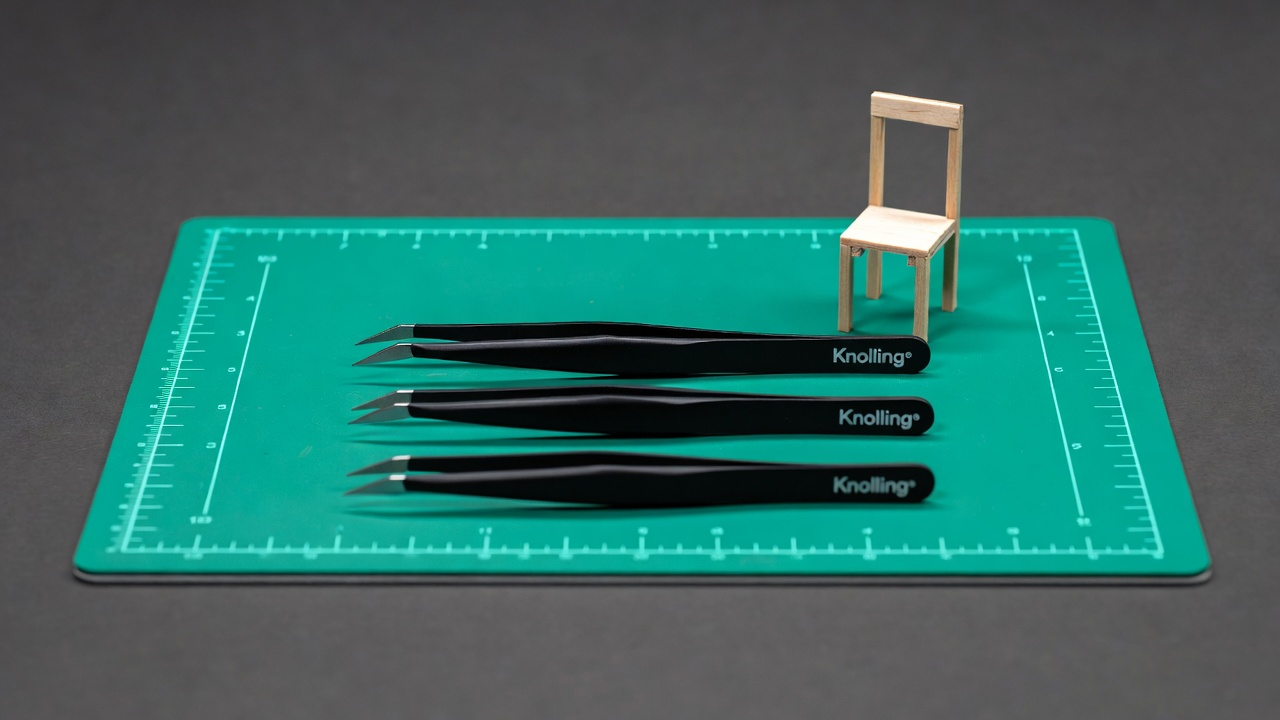
Your Fingers Are Sabotaging Your Miniatures (And You Know It)
Let me guess: you're trying to glue a 3 mm wooden chair leg onto a dollhouse table, and your thumb just smudged wet glue across the entire seat. Or you're peeling a tiny window decal, and your fingernail tore straight through it. Or—my personal favorite disaster—you're positioning a miniature book on a shelf, your hand cramps, you sneeze, and the book launches across the room, never to be seen again.
Your fingers are too big, too warm, too oily, and too clumsy for precision miniature work. I don't care how steady you think your hands are. Human fingers weren't designed to manipulate objects smaller than a grain of rice.
Steel was.
I've been building miniatures for fifteen years. I've built everything from 1:24 scale Rolife kits to 1:144 scale micro-architectural models. In that time, I've watched countless builders struggle with the cheap plastic tweezers that come bundled in kits. Those flimsy pink or blue things with tips that don't quite meet?
Throw them away. Right now.
They are worse than useless—they give you false confidence while destroying delicate pieces. They bend under pressure, they harbor static electricity, and they lack the mechanical grip to hold anything securely.
Professional miniature builders, watchmakers, jewelers, and surgeons all know the same secret: Precision work requires precision tools. You wouldn't perform surgery with a butter knife. Stop building miniatures with dollar-store tweezers.
This guide will teach you the only three pairs of tweezers you actually need—the curved workhorse, the straight needle-tip, and the reverse-grip clamp. I'll explain exactly why each design exists, what tasks each excels at, and why you should specifically look for ESD-coated (anti-static) black tweezers instead of shiny silver ones.
Why the "Free" Kit Tweezers Are Garbage
Before we talk about what to buy, we need to talk about why the free ones are sabotaging you. It comes down to three manufacturing flaws:
- The Molding Seam: Cheap plastic tweezers are made in a mold. If you look closely at the tip, there is often a tiny ridge of leftover plastic (flash) right where the tips grip. This prevents them from closing flush, meaning you can't grip anything thinner than that ridge.
- Plastic Memory: Plastic wants to return to its original shape. When you squeeze them, they fight back. When you release, they spring open too wide.
- Static Magnets: Cheap plastic builds up static charge instantly. If you try to pick up a paper flower petal, it will jump onto the tweezer and refuse to let go.
The Solution: Surgical Grade Stainless Steel. You need tools that are non-magnetic, corrosion-resistant (glue won't rust them), and machined to within 0.01 mm tolerances.

Tweezer #1: Curved Tip (ESD-11)—The Workhorse
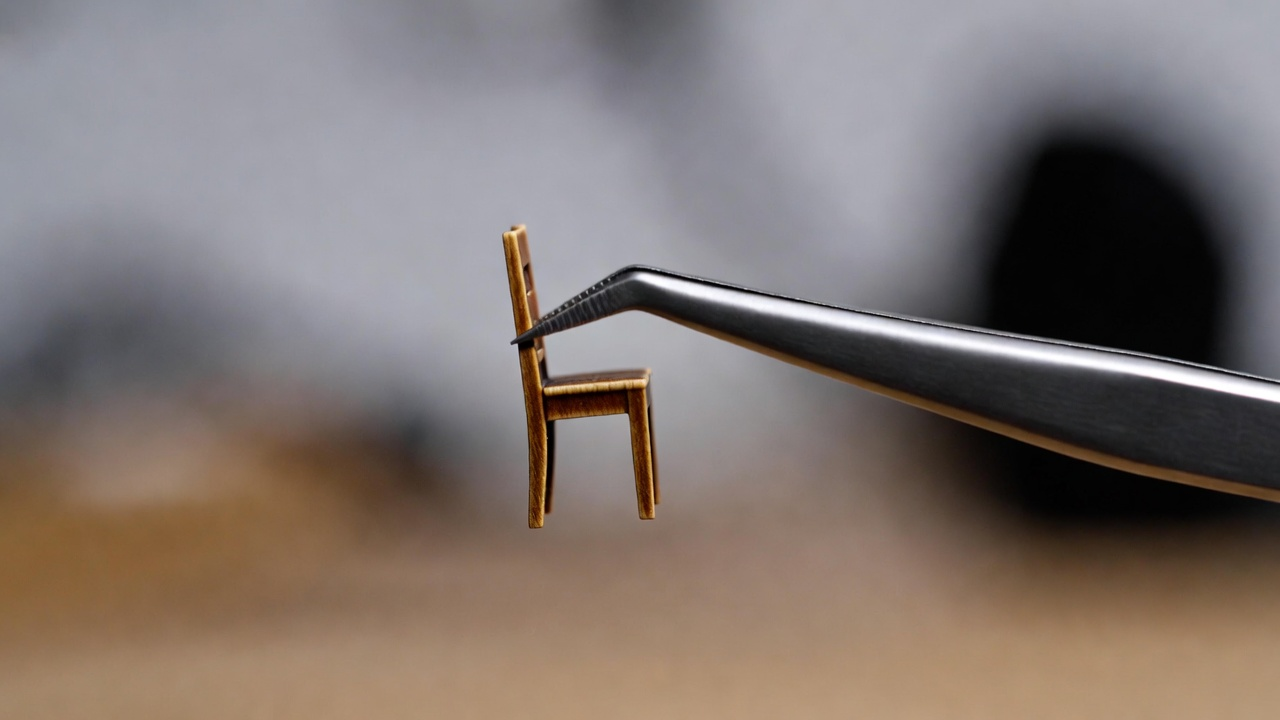
What It Looks Like Curved tweezers have a sharp 45-degree bend about 7mm from the tip. When you hold them naturally (like a pen), the tips point downward and slightly forward. Think of them as the tweezers equivalent of a good chef's knife: versatile, reliable, and 80% of your work will use them.
The Physics of the Curve Here is the biomechanical reality: When you use straight tweezers on a flat surface (like a dollhouse floor), your hand has to hover directly over the object to grip it. Your knuckles block your view, and your hand casts a shadow on the work area. The "Offset" Solution: The 45-degree angle of the ESD-11 allows your hand to rest comfortably on the table away from the object, while the tips reach in and touch the surface.
- Result: You have a clear line of sight. You can see the exact millisecond the glue touches the floor.
Best Uses:
- Placing Miniature Books: This is the killer app. You can grip the book by the spine, angle your hand comfortably, and slide it onto the shelf without your fingers bumping the walls.
- Applying Decals: The curve allows you to "roll" the sticker onto the surface smoothly, preventing air bubbles.
- Handling "Flat" Objects: Picking up a flat wooden tile from a table is impossible with fingers. The curved tip slides under the edge like a spatula.
What to Buy: Look for ESD-11 Curved Tweezers.
Tweezer #2: Straight Fine Tip (ESD-15) — The Specialist
What It Looks Like These are perfectly straight from handle to tip, tapering to an almost invisible needle point. Some are as fine as 0.1mm. Warning: These are sharp. If you drop them on your foot, they will stick. Treat them like a scalpel.
Why Straight Beats Curved (Sometimes) Curved tweezers are great for floors, but terrible for vertical precision. If you need to thread a wire through a hole in a wall, curved tweezers feel clumsy. Straight tweezers act as an extension of your finger, providing a direct line of force.
Best Uses:
- The "Sticker Peel": Fingernails are too thick to peel the backing off tiny window decals. The needle-tip of an ESD-15 can slide between the paper layers surgically.
- Threading LED Wires: Need to pull a copper wire through a 2mm hole? Straight tweezers can reach through, grab the wire, and pull it back.
- Seed Beads: If you are building a miniature chandelier, only a straight tip can grip a 1mm bead securely.
The Danger Zone (Handle With Care) Because the tips are so fine, they are fragile.
- Never use them as a pry bar. If you try to pry open a paint can or separate glued wood, the tips will bend.
- Store them with the cap on. One drop onto a concrete floor will blunt the tip forever.
What to Buy: Look for ESD-15 Fine Tip Tweezers. (link below)
Tweezer #3: Reverse-Grip (Cross-Action) — The Third Hand
What They Look Like: These look backwards. The handle has an "X" shape.
- Normal Tweezers: Squeeze to Close. (Requires constant muscle force).
- Reverse Tweezers: Squeeze to Open. (The resting state is clamped shut).
The Hand-Fatigue Solution Picture this: You are gluing a miniature railing to a staircase. You need to hold the railing perfectly still for 60 seconds while the glue tacks up. With normal tweezers, you have to maintain constant, perfect pressure for that full minute. Your hand will start to shake. The railing will wobble. The glue will dry crooked. With reverse-grip tweezers, you squeeze to open them, place the railing in the jaws, and let go. The tweezers clamp down automatically using their own spring tension. You can set the whole assembly on the table and walk away.
Best Uses:
- The "Glue Clamp": Holding two pieces together while glue dries.
- Soldering: Clamping a wire steady so both your hands are free for the soldering iron and solder.
- Painting: Clamp a miniature figure by the base. Hold the tweezer handle like a paintbrush. Now you can rotate the figure steadily without touching the wet paint.
What to Buy: Look for Cross-Locking or Reverse Action Tweezers.
The ESD Coating Advantage (Why Black > Silver)
You have probably noticed that professional tweezers are often matte black, not shiny silver. This isn't just a fashion choice. It is ESD (Electrostatic Discharge) protection.
1. The Static Problem Uncoated metal builds up static electricity from friction. In the miniature world, this is a nightmare.
- Scenario: You pick up a tiny piece of tissue paper for a flower. You try to place it. It won't let go of the tweezers. You shake the tweezers. It still sticks.
- The Fix: ESD coating dissipates the static charge instantly. The paper releases exactly when you open the jaws.
2. The Glare Problem Building miniatures requires bright task lighting. Shiny chrome tweezers reflect that light directly into your eyes, causing fatigue. Matte black absorbs the light, saving your vision during long build sessions.
My Advice: Always pay the extra $2 for the black ones.
Maintenance: How to Clean Glue Off Your Tweezers
If you build miniatures, you will get glue on your tweezers. If you let it dry, it creates a lump that prevents the tips from closing properly.
The "Acetone" Method:
- For Super Glue (CA): Soak the tips in a jar of pure Acetone (nail polish remover) for 5 minutes. The glue will dissolve. Wipe clean.
- For Tacky Glue: Soak in warm soapy water for 10 minutes. Scrub with an old toothbrush.
The "File" Method (Recovering Damaged Tips): If you dropped your straight tweezers and the very tip hooked slightly, don't throw them away.
- Take a metal nail file or 400-grit sandpaper.
- Gently, gently file the inner surface of the bent tip.
- Squeeze them shut and look at the light. If they close flush again, you saved them.
Building Your Arsenal (The Investment)
You don't need a 10-piece set. You need these three high-quality tools.
Your Shopping List:
- ESD-11 Curved Tweezers (The daily driver).
- ESD-15 Straight Tweezers (The surgical specialist).
- Reverse-Grip Tweezers (The mechanical clamp).
Total Investment: Approx $35.
Compare that to the cost of ruining a $50 kit because you dropped a critical piece, or the frustration of hand cramps ruining your hobby time. Quality tweezers aren't an expense; they are an investment in your sanity.
Stop fighting your tools. Let the steel do the work.
Read Also: Help! I Broke a Piece: How to Fix Broken Wooden Parts in Miniature Kits