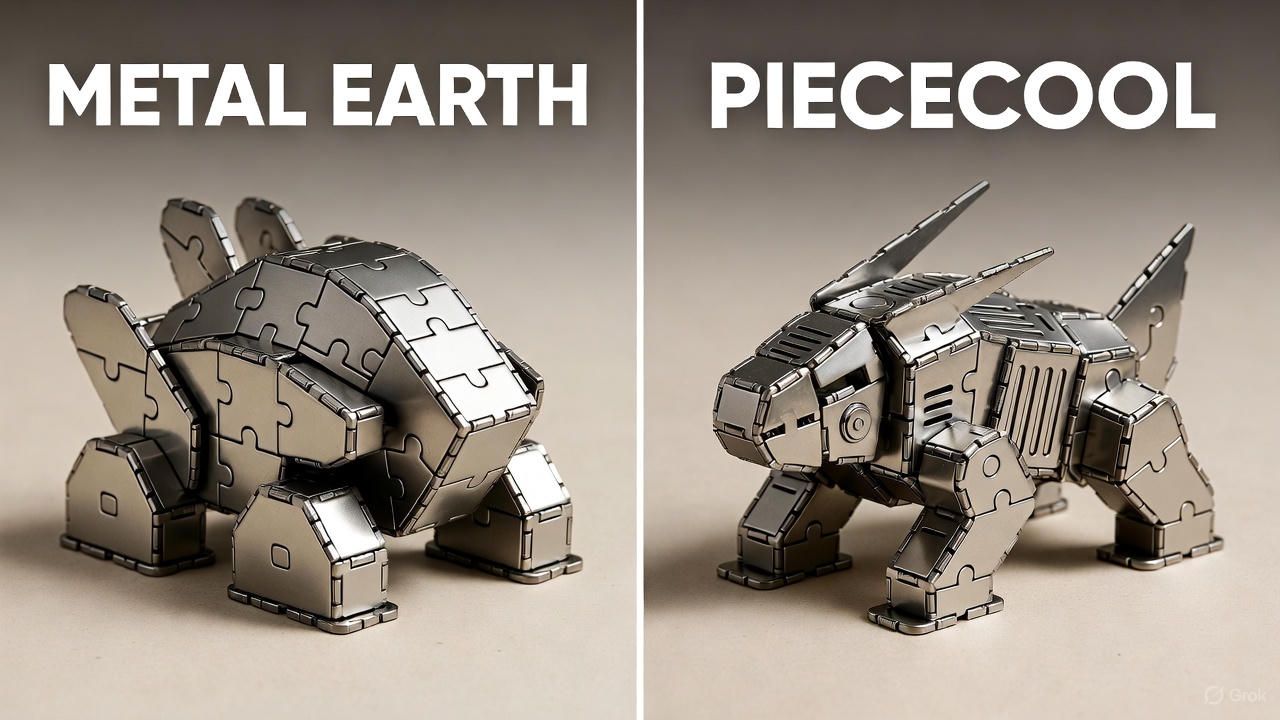
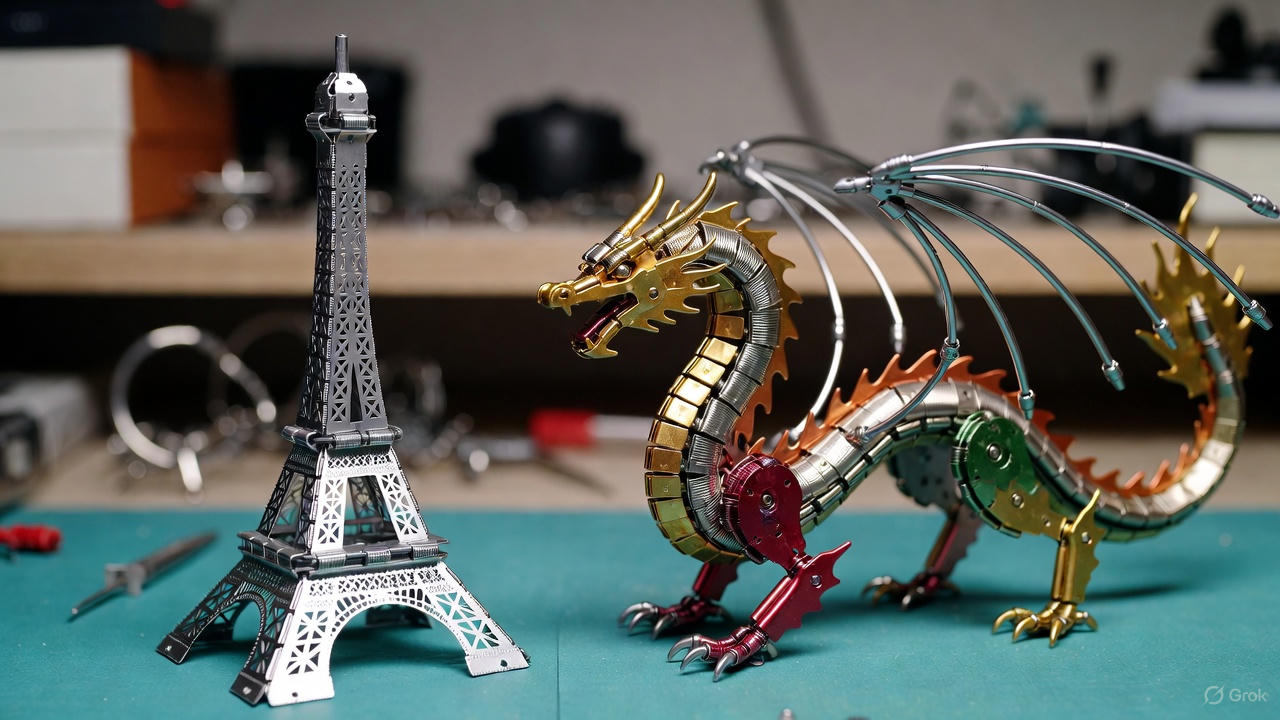
After spending fifteen years building over 300 metal model kits—from simple Metal Earth landmarks to elaborate Piececool mechanical dragons spanning 500+ pieces—I've developed a deep understanding of what separates successful first builds from abandoned frustrations.
Metal modeling represents a fundamentally different craft than wooden miniatures or plastic model kits. It offers unique challenges, specialized techniques, and distinct satisfaction when you complete a gleaming steel sculpture assembled entirely without adhesives.
This comprehensive guide draws from extensive hands-on experience with both Metal Earth (manufactured by Fascinations, Inc.) and Piececool (a premium Chinese metal craft brand), documenting the technical differences, skill requirements, and strategic considerations that determine whether your first metal model becomes a treasured display piece or a box of crumpled frustration.
Understanding 3D Metal Models.
Unlike wooden kits that rely on adhesive bonds or plastic kits requiring cement welding, metal models use purely mechanical connections. Each joint consists of a metal tab inserted through a corresponding slot, then either folded flat or twisted perpendicular to lock the connection.
The Appeal: If you've built fifty wooden book nooks and the process has become repetitive, metal modeling introduces entirely new challenges: understanding metal fatigue limits, developing fine motor control for microscopic tabs, and learning to "read" three-dimensional structures from flat patterns.
The Intimidation: Metal sheets have razor-sharp edges. The components are often smaller than wooden kit pieces. And unlike wood—where a poorly glued joint can be separated and redone—bent metal tabs are permanent. Mistakes require creative problem-solving or acceptance of imperfection.
Metal Earth (Fascinations): The Accessible Gateway.
Metal Earth launched in 2010 focusing on licensed recognizable properties (Star Wars, Marvel, Harry Potter, NASA) and positioning models as accessible entry points for curious buyers.
Technical Specifications
- Primary material: 430 stainless steel (magnetic grade, corrosion-resistant).
- Sheet thickness: 0.2mm (±0.02mm tolerance).
- Surface finish: Matte silver (natural steel appearance); colored models use powder coating.
- Average piece count: 15-60 components per model.
- Smallest tab dimensions: Approximately 0.5mm × 2mm (requires precision tool handling).
Build Time Expectations:
- Simple (Eiffel Tower): 45-90 minutes.
- Intermediate (Star Wars X-Wing): 2-4 hours.
- Complex (Hogwarts Castle): 6-12+ hours.
Why Beginners Should Start Here
- Availability: widely stocked in physical retail locations like Barnes & Noble and Michaels. You can examine packaging and verify completeness before buying.
- Lower Financial Risk: At $10-15 for most beginner models, the cost of potential failure is minimal. If you accidentally ruin a model during learning, you haven't invested $50.
- Standardized Instructions: Metal Earth uses consistent instruction design. Once you learn to read their symbol system, the skills transfer to every other model in their catalog.
- Licensing: If you're a Star Wars enthusiast, the licensed models provide immediate motivation to complete the build carefully.
The Drawbacks
- Microscopic Scale: Tabs measuring 0.5mm wide require tweezers. During my build of the Metal Earth AT-AT, I dropped a tiny leg component into the carpet and spent twenty minutes searching on my hands and knees.
- Material Brittleness: The 0.2mm stainless steel has limited flexibility. Bend a tab more than three times (initial fold, correction, second correction), and it will likely snap.
Metal Earth vs. Piececool: The Decision Matrix
| Image | Product | Rating | Features | Action |
|---|---|---|---|---|
 | Best for Beginners Metal Earth | ★★★★★ |
| Shop Metal Earth at Amazon |
 | Best for Display Piececool | ★★★★★ |
| Shop Piececool at Amazon |
Metal Earth
- Affordable ($10-15)
- Licensed Themes (Star Wars)
- 1-2 Hour Builds
Piececool: The Premium Alternative
Piececool emerged around 2014, targeting the premium segment with elaborate Chinese cultural subjects (dragons, ancient architecture) and mechanical marvels.
Technical Specifications
- Primary material: Brass alloy (typically 65% copper, 35% zinc).
- Sheet thickness: 0.2mm to 0.4mm (thicker than Metal Earth, providing more structural rigidity).
- Surface finish: Gold plating, antique bronze, colored lacquer, or polished brass.
- Average piece count: 80-500+ components.
- Fold line marking: More pronounced scoring (approximately 0.1mm deep), easier to see and feel.
Why Choose Piececool?
- Visual Drama: Piececool's colored finishes—deep reds, antique bronzes—create models that function as decorative art pieces. My Piececool gold dragon sits prominently on my display shelf, immediately drawing attention, whereas my silver Metal Earth models blend into the background.
- Larger Components: While Piececool models have more total pieces, the average piece size is larger than Metal Earth's microscopic components. This makes handling easier. During my Piececool steam locomotive build (380 pieces), I dropped components less than half as often as comparable Metal Earth builds.
- Mechanical Functionality: Many models include functional mechanisms. The Mechanical Music Box plays music; the Dragon with Moving Wings features articulated joints.
- Premium Presentation: Brass sheets come individually wrapped to prevent scratching, and instructions are printed on heavy, full-color paper stock.
The Drawbacks
- High Cost: Models typically range from $30 to $150+. This is a significant investment for a beginner.
- Overwhelming Complexity: Piececool's simplest models match Metal Earth's intermediate tier. I've seen beginners abandon partially completed Piececool models after 8 hours, frustrated by the sheer volume of work.
The Fundamental Technique: Tabs and Slots
Understanding the mechanical connection system is essential. Unlike glue joints, bent metal tabs are permanent.
1. Fold Tabs (90-Degree Flat Fold)
Purpose: Creates flush, low-profile joints where surfaces meet. Technique: Insert the tab fully, then use flat-nose pliers to press it flat against the surface. Common Mistake: Incomplete insertion. If you don't push the tab all the way through before folding, the connection will be loose and wobbly.
2. Twist Tabs (90-Degree Twist)
Purpose: Creates mechanical locks that allow some movement or extra strength. Technique: Insert the tab, grip it with needle-nose pliers, and rotate 90 degrees. The twisted metal wedges against the slot edges. Note: Twist tabs are generally stronger than fold tabs and are often used for internal structures.
3. Rolled Cylinders
Purpose: Creating barrels, towers, or engines. Technique: You must use a mandrel (like a drill bit or pen) to curl the metal. Do not try to bend it with your fingers; it will kink into an oval shape instead of a smooth circle.
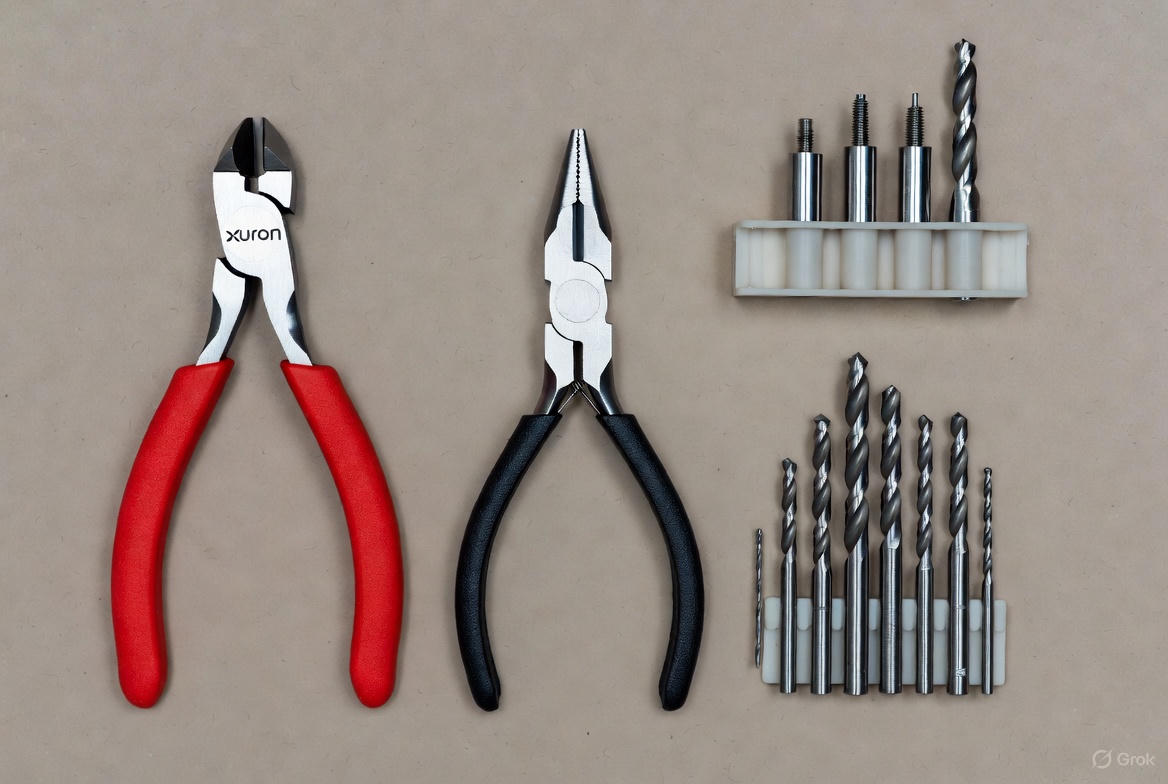
Essential Tools: The Non-Negotiables
Attempting metal model construction with inadequate tools guarantees frustration.
Tool 1: Flush-Cut Sprue Cutters (Mandatory).
Why: Scissors twist the metal, warping components before you even start. Recommendation: Xuron 410 Micro-Shear Flush Cutters ($12-15). These feature ultra-sharp blades designed specifically for photo-etched metal.
Tool 2: Smooth-Jaw Pliers
Why: Standard pliers have serrated "teeth" that scratch the polished metal finish. Recommendation: Xuron 450TN Tweezer Nose Pliers or any jewelry pliers with smooth jaws. If you only have standard pliers, wrap the jaws in electrical tape.
Tool 3: Precision Tweezers
Why: Holding components too small for pliers (especially for Metal Earth). Recommendation: Vetus ESD-15 Precision Tweezers. The anti-static coating prevents lightweight components from clinging to the tool.
Tool 4: Cylindrical Mandrels
Why: Rolling perfect cylinders. Recommendation: A standard Drill Bit Index Set (1mm to 13mm). This provides every diameter you will ever need for about $20.
The Hybrid Approach: My Recommended Path
My personal recommendation for newcomers is to ignore the "Brand Loyalty" debate and instead use both brands to build your skills progressively.
- Step 1: Build one simple Metal Earth model ($10-12, 60-90 minutes). This teaches fundamental tab and slot techniques with minimal financial risk. Recommended: Eiffel Tower (MMS010).
- Step 2: Build one intermediate Metal Earth model ($15-20, 2-4 hours). This develops confidence with complex assembly sequences. Recommended: Star Wars X-Wing Fighter.
- Step 3: Transition to a moderately complex Piececool model ($35-45, 6-10 hours). The skills learned on Metal Earth directly transfer, but now you're working with larger pieces and more visually dramatic results. Recommended: The Qilin (Chinese Unicorn).
This progression minimizes financial risk while building skills in manageable increments. Jumping directly to a $60 Piececool dragon as your first metal model carries substantial risk of frustration.
Common Beginner Mistakes to Avoid
Mistake 1: Failing to Test-Fit
The Problem: Bending tabs immediately upon insertion without verifying orientation. The Consequence: Discovering after irreversible bending that a piece is installed upside-down. The Fix: Always insert the tab loosely and check the diagram. Only when you are 100% sure the piece is correct should you commit to the permanent bend.
Mistake 2: Using the Wrong Tools
The Problem: Using household scissors or fingernails. The Consequence: Warped metal, cut fingers, and loose connections. The Fix: Invest the $30 in proper cutters and pliers. I am still using the Xuron cutters I bought in 2012—they are a lifetime investment.
Mistake 3: Rushing Component Removal
The Problem: Cutting all pieces out of the sheet at the beginning. The Consequence: A messy pile of 200 tiny shards that are impossible to identify. The Fix: Only cut out the pieces you need for the current step. Leave the rest in the sheet until called for.
Conclusion: The Final Verdict
After 15 years and 300 builds, here is the bottom line:
Metal Earth provides the accessible entry point. It’s cheap, recognizable, and teaches you the skills. It is the logical starting point for curious beginners.
Piececool is the destination. It offers the visual reward, the mechanical complexity, and the "wow factor" that justifies the effort. Once you have mastered the basics, Piececool models function as genuine decorative art worthy of prominent display.
Metal Earth vs. Piececool: The Decision Matrix
| Image | Product | Rating | Features | Action |
|---|---|---|---|---|
| Best for Beginners Metal Earth | ★★★★★ |
| Shop Metal Earth at Amazon |
| Best for Display Piececool | ★★★★★ |
| Shop Piececool at Amazon |
Metal Earth
- Affordable ($10-15)
- Licensed Themes (Star Wars)
- 1-2 Hour Builds
The metal modeling community welcomes builders of all skill levels. Whether you are building a $12 Metal Earth landmark or a $60 Piececool masterpiece, the satisfaction is the same: transforming flat sheets into gleaming sculptures through pure engineering.
Now gather your tools, choose your first model, and begin building. The gleaming metal sculpture waiting inside those flat sheets is ready to take shape under your hands.